
The Value of On-Site Elemental Analysis in Mining
In mining, decision time is cost. Sending a drill core to the lab and waiting for results can take weeks, and in the meantime the field team works with incomplete information. The ability to run elemental analysis on site shortens that cycle, enabling real-time management of exploration programs, ore boundary definition and grade control.
The economic payoff is twofold. First, fewer samples sent to the lab means lower analysis costs. Second, and more importantly, making decisions at the right time keeps ore from ending up on the waste dump and waste from diluting the ore. Fast field measurement does not replace lab analysis, but it decides which samples need to go to the lab, making the whole chain more efficient.
Ore Grade Control and Geochemical Mapping
Elemental analysis is used most heavily in geochemical mapping and anomaly detection during exploration, core and chip analysis during drilling, grade control and blending decisions in the pit, and feed and concentrate monitoring at the processing plant. Base metals, precious metals and pathfinder elements are reported in a single measurement, enabling a fast preliminary assessment right at the core table. Measurements tagged with location and image data feed directly into geochemical maps.
Critical Minerals and Light Element Analysis
Lithium, rare earth elements and other critical minerals have gained strategic importance with the energy transition and advanced technology. Some of these elements fall outside the sensitivity range of conventional XRF. Laser-based spectroscopy adds complementary capability by detecting light elements such as lithium and beryllium in the field. Mineralogical examination reveals grain size, liberation and composition, providing data for processing circuit design and recovery improvement.
Mining Equipment Inspection and Maintenance Safety
The second pillar is the integrity of heavy equipment. Crushers, mills, conveyors, silos and slurry lines run under constant impact and abrasion. Crack detection on crusher bodies and chassis welds, thickness measurement on silo and bin walls, and monitoring of wear-driven thinning in slurry lines help prevent unplanned stoppages and environmental risks. In hard-to-reach areas, visual inspection technology enables condition assessment without disassembly.
Standards in the Mining Industry
XRF analysis of ores and geological materials follows standards such as ISO 18227 and ASTM E1621, and sampling procedures are defined by ISO 3082. Resource and reserve reporting follows the JORC and NI 43-101 codes internationally. In Turkey, mining activity reporting is regulated by the General Directorate of Mining and Petroleum Affairs (MAPEG). Soil and waste analyses carried out for environmental monitoring are evaluated against regulatory limit values.
Common Analysis and Inspection Methods in Mining
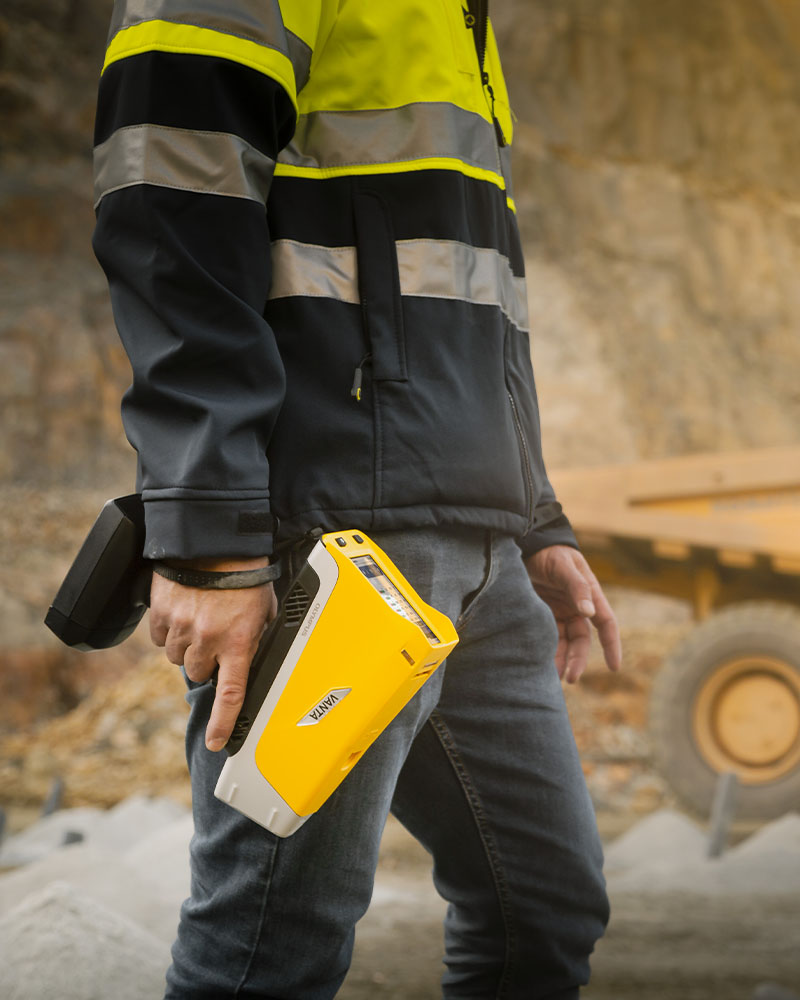
XRF Analyzers. Perform multi-element analysis in the field, at the core table and at the drill collar without sample preparation. The core tool for grade control, ore boundary definition and geochemical mapping.
LIBS Spectrometers. Detect light elements such as lithium and beryllium in the field, adding complementary capability for critical mineral projects.
Scanning Electron Microscopes (SEM). Reveal grain size, liberation and composition of minerals, providing data for processing circuit design.
Ultrasonic Testing. Monitors wear-driven thickness loss in crusher bodies, silo and bin walls and slurry lines.
Sample Preparation Equipment. Crushing, grinding, splitting and pellet pressing ensure the sample truly represents the field. Much of the analytical accuracy is decided at this stage.
Videoscopes. Inspect inaccessible areas of mills, crushers and conveyors without disassembly.
Optical Emission (OES) Spectrometers, Magnetic Particle & Penetrant Testing, Hardness Testers and Phased Array & TOFD are also widely used in mining applications.